

.png)


.png)


- FIND GLOVES BY HAZARD
-
FIND GLOVES BY INDUSTRY
-
Food

-
Printing

-
Engineering

-
Automotive

-
Chemical

-
Railways

-
Metallurgy

-
Healthcare

-
Packaging

-
Mechanical

-
Glass

-
Electronics
-
Utilities

-
Construction

-
Landscaping

-
DIY

-
Outdoor Sports

-
Mining

-
Airports & Ports

-
Janitorial

-
Manufacturing

-
Warehousing & Distribution

-
Clean Room

-
Pharmaceutical

-
Aerospace

-
Laboratory

-
Municipal services

-
Agriculture

-
Commercial Fishing

-
Oil and Gas

-

The Optimal Intersection: An Educational Strategy Guide to Navigating the Glove Gauge Challenge
Blog | 2026-01-23

💡 Setting the Standard: The SHOWA Perspective on Hand Protection
For years, procurement teams and safety managers have relied on simple, quantitative metrics to define a ‘better’ product. In the world of high-performance cut-resistant gloves, this conversation is almost always dominated by two numbers: the Cut Protection Level (ANSI/EN) and the Gauge.
The current market is seeing an aggressive push towards ultra-high gauge gloves—specifically, those marketed at 21-gauge (21G) and even 24-gauge (24G). The pitch is compellingly simple: a higher gauge number implies a thinner knit, which must mean superior dexterity and ‘bare-hand feel.’
As a fully integrated manufacturer dedicated to industrial hand protection, SHOWA must take a clear, definitive stand on this technological challenge. Our position is not merely defensive; it is assertive and educational. We are not simply debating numbers; we are defining value and longevity in the industrial context.
This educational guide is designed to equip our entire sales ecosystem to confidently steer the conversation away from the simplistic gauge comparison and toward the Total Value of the SHOWA knitting, yarn, and coating system. We must position the SHOWA 18-gauge (specifically, products like the S-TEX Alpha XC820) not just as a competitor, but as the Optimal Choice—the proven sweet spot where sensitivity meets industrial sustainability.
1. Deconstructing the Metric: Understanding the Gauge Continuum
What Gauge Really Means
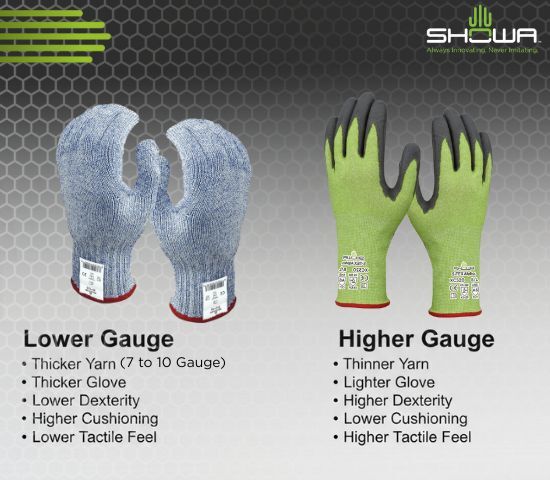
Gauge refers to the number of stitches, or needles, per inch used to knit the liner of a glove.
- Low Gauge (7G, 10G): Fewer stitches per inch, resulting in a thicker, bulkier knit. These gloves offer maximum material strength and often superior warmth, sacrificing high dexterity. They are typically used for heavy-duty applications where bulk is not an issue, such as handling rough materials or cold storage.
- Higher Gauge (13G, 15G, 18G): More stitches per inch, resulting in a thinner, finer knit. The intention is to increase dexterity and tactile sensitivity for fine motor tasks, manipulation of small parts, and comfortable, extended wear.
The Point of Diminishing Returns (The Critical Pivot)
Our strategic focus centers on what happens after 18-gauge. We must establish the narrative that dexterity beyond 18-gauge is often an exercise in diminishing returns.
Past the 18-gauge threshold, the continuous pursuit of thinness begins to actively compromise the very structure of the yarn and the overall integrity of the glove.
The Pivot: “When the knit is pushed beyond 18-gauge, it becomes so fine that the structural integrity of the yarn is compromised, leading to significantly faster wear-out and, inevitably, a much higher Total Cost of Ownership (TCO).”
This is the key message. We are not dismissing 21G/24G gloves outright; we are using them as a foil to highlight the inherent trade-off. We are showing that in the real-world industrial setting, the minimal gain in ‘feel’ achieved by shedding those last few fibers is not a technical advantage—it’s an economic liability.
2. The Dexterity Truth: Why It’s a System, Not a Number
The competitive challenge relies on the customer believing that dexterity is solely dictated by the gauge number. Our goal is to shatter this perception. True dexterity is a complex synergy determined by the entire glove system: the coating, the yarn material, and the precision of the knit.
The Role of Coating Technology
A customer’s actual ‘feel’ and grip is primarily facilitated by the coating that covers the palm and fingers. This is where SHOWA’s technology truly shines.
- SHOWA Technology: The quality, formulation, and application method of our Nitrile and proprietary coatings ensure a glove that conforms ergonomically to the hand. Our thin, breathable coatings are designed to maximize grip and flexibility without the bulk associated with inferior dipped gloves.
- The Argument:The minor difference in liner thickness between an 18-gauge and a 21-gauge is far less impactful on dexterity than the difference between a superior, engineered SHOWA coating and a generic, thick competitor coating.
The Role of Advanced Yarn Material
The underlying yarn itself dictates the ability of the glove to offer protection while remaining thin.
- Competitive Challenge: Many high-gauge competitors rely on simple, standard fibers that are merely knitted to an extreme thinness. To achieve necessary cut protection (e.g., ANSI A5 or A6), they must push to 21G or higher, because their underlying fiber material is weak.
- SHOWA Technology Difference: SHOWA gloves, such as the 18G S-TEX Alpha XC820, utilize advanced fibers like our proprietary Tungsten yarn blend. This technology achieves superior cut protection at the 18-gauge level. Because our yarn is stronger, we don’t need to compromise the durability of the knit by pushing it to 21G or 24G.
The Strategic Pivot: “Ask the customer: Is the extra 5% of ‘feel’ worth a 50% drop in lifespan?” SHOWA gives you 95% of the feel with 200% of the durability. By showcasing our integrated system, we make the high gauge number of the competition utterly unnecessary.
3. Durability vs. Sensitivity: Winning the TCO Argument
This is the commercial objective: shifting the conversation from a one-time purchase price to the long-term cost. We must teach the sales team to pivot hard to the Total Cost of Ownership (TCO).
The Inherent Fragility of High Gauge
The primary failure point of many ultra-high gauge competitor gloves is their inability to sustain daily industrial friction and wear.
The Pivot: “Higher gauge gloves often fail on the first day of serious use. Our focus is on the long-term cost. We don’t sell ‘single-use’ liners.”
When a liner is too thin, the critical integrity of the fiber is compromised. This leads to a rapid breakdown of the coating, tearing at critical points of the knit, and catastrophic failures in areas of high stress. The short lifespan forces the customer to replace gloves more frequently, escalating their annual budget dramatically.
The Optimal Intersection (The SHOWA Zone)
The SHOWA 18-gauge is strategically positioned as the Optimal Intersection—The ‘sweet spot’ where maximum cut protection (confirmed at ANSI A6 for the S-TEX Alpha XC820) and necessary dexterity still meet non-negotiable industrial durability standards.
This is the definition of true value:
- Safety Delivered: Maximum cut protection (A6).
- Performance Enabled: High dexterity for complex tasks.
- Cost Controlled: Longevity that slashes replacement costs.
By focusing on the integrity of our 18-gauge knit coupled with superior yarn technology, we offer a glove that lasts significantly longer than the fragile, high-gauge alternatives. When we perform a TCO audit, the data proves that eliminating frequent replacements provides far greater savings than any perceived “saving” on the initial unit cost of a 21G glove.
4. Competitive Advantage: The Authority of Integrated Manufacturing
Our final educational point, which reinforces our thought leadership, is to remind our audience of our structural advantage as a fully integrated manufacturer.
SHOWA controls the industrial ecosystem: we design the machinery, engineer the yarns (like Tungsten), formulate the coatings, and control the knitting process. We don’t buy off-the-shelf components and assemble them; we own the technology from start to finish.
This allows us to certify that our 18-gauge products are precisely engineered to balance all three critical factors—protection, feel, and durability—without needing to resort to the gimmick of ultra-thin, structurally weak gauges.
Conclusion:The Choice for Long-Term Value
The message to our sales team and our customers is one of maturity and insight: Don’t chase a single number. Don’t be trapped by a gimmick.
A true hand protection partner offers solutions that reduce injuries, enhance performance, and—critically—lower your costs over the long term. Products with higher lifespan and longevity are more sustainable than the contrary; using a protective glove with two or more times the durability means significantly less material is used for the expected protective performance over a given time period. Using more raw materials and energy for inferior performance cannot match the increasing requirements of sustainable product supply. SHOWA’s technology results in more sustainable protective gloves that reduce TCO. The SHOWA 18-gauge system is designed for maximum cut protection, superior dexterity, and unbeatable industrial life. This is the definition of Optimal. This is the definition of SHOWA.
The Call to Action: Contact us for more information to schedule an in-depth S-TEX Alpha XC820 demonstration and a comparative.