.png)


.png)


- FIND GLOVES BY HAZARD
-
FIND GLOVES BY INDUSTRY
-
Aerospace

-
Agriculture

-
Airports & Ports

-
Automotive

-
Chemical

-
Clean room

-
Commercial fishing

-
Construction

-
DIY

-
Electronics

-
Engineering

-
Food

-
Glass

-
Healthcare

-
Janitorial

-
Laboratory

-
Landscaping

-
Manufacturing

-
Mechanical

-
Metallurgy

-
Mining

-
Municipal services

-
Oil and gas

-
Outdoor sports

-
Packaging

-
Pharmaceutical

-
Printing

-
Railways

-
Utilities

-
Warehousing & Distribution

-

Mastering ESD Protection: Essential Electrostatic Dissipative Hand Protection for Electronics & Microchip Manufacturing
User Case Studies | 2025-04-08
Protecting Against Electrostatic Discharge (ESD)
In the hyper-precise realm of electronics and microchip manufacturing, electrostatic discharge (ESD) presents a formidable threat. Even the slightest static shock can induce critical failures, leading to substantial financial losses and operational disruptions. This article serves as your definitive guide to ESD gloves, dissecting their types, crucial features, and pivotal role in safeguarding both personnel and valuable equipment. We’ll also highlight the industry-leading solutions offered by SHOWA, ensuring your operations remain shielded from the perils of ESD.
Understanding Electrostatic Discharge (ESD)
What is ESD? Electrostatic discharge is the abrupt flow of electrical charge between objects with differing electrical potentials. This rapid transfer, often triggered by contact or dielectric breakdown, can generate thousands of volts in mere microseconds. While humans may only experience a minor shock, these high-voltage events are catastrophic for sensitive electronic components like microchips, circuit boards, and semiconductors. Within ESD Protected Areas (EPAs), where these delicate components are handled, the risk escalates exponentially, underscoring the necessity of antistatic gloves.
The Critical Role of ESD Hand Protection in Electronics Manufacturing
Human hands, natural accumulators and dischargers of static electricity, are primary vectors for ESD events in electronics manufacturing. Workers manipulate intricate components, assemble complex devices, and perform delicate repairs, creating a direct pathway for static discharge to damage sensitive equipment. ESD gloves act as a fundamental barrier, preventing the buildup and discharge of static electricity through the hands. Implementing the correct ESD protection gloves is not merely a safety measure; it’s a strategic imperative to uphold product integrity, avert costly damage, and protect personnel.
Types of ESD Gloves: Tailoring Protection to Specific Applications
Selecting the appropriate ESD safety gloves depends on the specific requirements of your application. Here’s a breakdown of the common types:
- Conductive Gloves: These gloves exhibit ultra-low electrical resistance (typically less than 105 Ohms/square), facilitating rapid charge dissipation. Ideal for applications requiring swift and efficient charge transfer.
- Static Dissipative Gloves: These gloves have moderate electrical resistance (105 to 1011 Ohms/square), providing a controlled and gradual charge dissipation. Suitable for general ESD protection in most electronics manufacturing settings.
- Insulative Gloves: These gloves possess high electrical resistance (greater than 1012 Ohms/square), effectively preventing electron flow. Primarily used for electrical safety in high-voltage environments, not ideal for ESD protection in sensitive electronics.
- Anti-Static Gloves: These gloves are specifically designed to prevent triboelectric charging, which is the buildup of static electricity caused by friction.
Key Features of High-Performance ESD Gloves: Ensuring Optimal Protection
When selecting anti static work gloves, consider these crucial features:
- Surface Resistivity: Must be tested using industry standards such as ANSI/ESD STM15.1-2019, ensuring consistent static charge dissipation.
- Material and Coating:
- Nitrile coatings, like S-embossed, offer superior grip and durability.
- Carbon-loaded polymers and conductive fibers provide effective ESD protection.
- Touch Panel Compatibility: Enables seamless interaction with touch screen devices without compromising ESD protection.
- Ergonomic Design: Lightweight and comfortable for extended wear, reducing fatigue and enhancing productivity.
- Optimal Liner Design: Improves comfort and breathability.
- Chemical and Oil Resistance: Provides added protection in demanding industrial applications.
- Cut Resistance: Protects users from sharp objects, rated with ANSI Cut levels such as ANSI Cut A1/A8.
SHOWA: Pioneering ESD Hand Protection Innovations
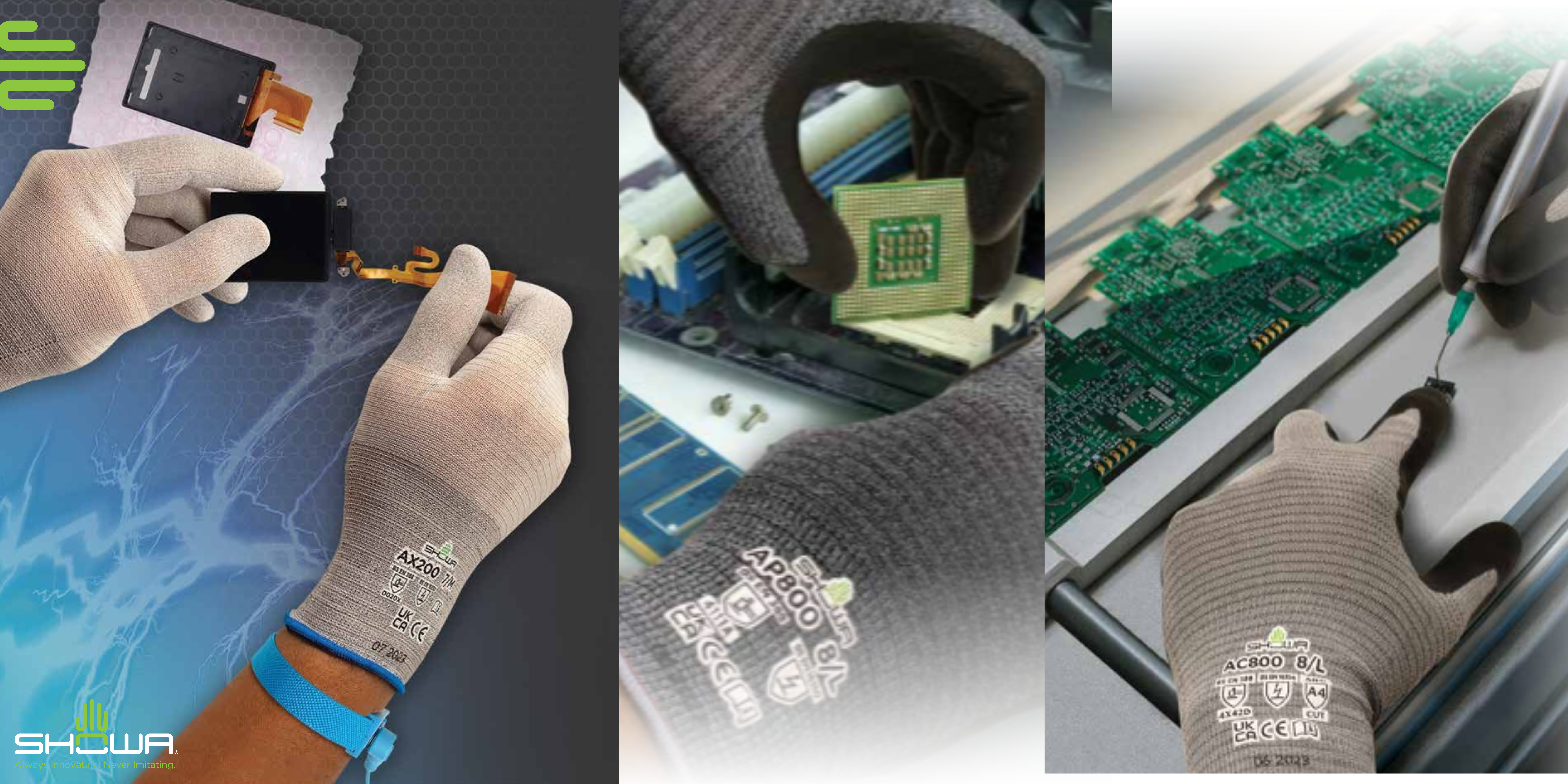
SHOWA, a leader in hand protection, offers a comprehensive range of ESD gloves engineered for sensitive applications requiring ESD protection. Notable product lines include:
- SHOWA AX200: Touch panel capable, ergonomic.
- SHOWA DURACoil Alpha AC800: ANSI Cut A4 rated, S-embossed nitrile foam coating, touch panel compatible, lightweight comfort.
- SHOWA DURACoil Alpha AC200: ANSI Cut A4 rated, optimal liner, touch panel capable.
- SHOWA 660ESDR: Chemical and oil resistant, with full PVC coating and rough grip for demanding industrial settings. (Note: Not suitable for electronics cleanroom applications.)
A Holistic ESD Control Program: Multi-Layered Protection
Beyond ESD gloves, a comprehensive ESD control program should encompass:
- Grounding: ESD wrist straps and mats provide a direct path to ground, preventing static charge accumulation.
- ESD Footwear and Clothing: Minimizes charge buildup on personnel.
- Humidity Control: Maintaining appropriate humidity levels reduces ESD risk.
Industry Applications: Where ESD Protection is Essential
ESD gloves are crucial in various industries:
- Aerospace
- Automotive
- Electronics manufacturing
- Cleanroom environments
- Automotive repair and maintenance
- Intricate parts handling
- Light assembly of oil-coated pieces.
- Mechanical and engineering
- All kinds of industries operating in ATEX zones
Frequently Asked Questions (FAQ)
- Q: What is the difference between conductive and static dissipative gloves?A: Conductive gloves have very low resistance for rapid charge dissipation, while static dissipative gloves have moderate resistance for controlled dissipation.
- Q: What ANSI/ESD standard should ESD gloves meet?A: ESD gloves should meet ANSI/ESD STM15.1-2019 standards for consistent performance in North America. However, for European applications, compliance with EN 1149-5 (protection of the manipulated product) and/or EN 16350 (ATEX) standards is required.
- Q: How does humidity control help with ESD prevention?A: Higher humidity levels help dissipate static charge, reducing the risk of ESD events.
- Q: What are the benefits of touch panel capable ESD gloves?A: They allow workers to interact with touch screen devices without removing gloves, maintaining ESD protection.
Conclusion
In the electronics and microchip industries, ESD protection is not optional; it’s essential. High-quality ESD gloves, like those from SHOWA, combined with a comprehensive ESD control program, protect workers, safeguard equipment, and ensure product integrity. By investing in robust ESD protection measures, businesses can minimize risks, enhance productivity, and gain a competitive edge in the technology-driven market.
Call to Action
Explore our comprehensive range of antistatic work gloves to safeguard your operations. Scan the QR code for more information and to find the ideal ESD protection solution for your needs.Learn more about this topic on our website .