

.png)


.png)


- FIND GLOVES BY HAZARD
-
FIND GLOVES BY INDUSTRY
-
Food

-
Printing

-
Engineering

-
Automotive

-
Chemical

-
Railways

-
Metallurgy

-
Healthcare

-
Packaging

-
Mechanical

-
Glass

-
Electronics

-
Utilities

-
Construction

-
Landscaping

-
DIY

-
Outdoor Sports

-
Mining

-
Airports & Ports

-
Janitorial

-
Manufacturing

-
Warehousing & Distribution

-
Clean Room

-
Pharmaceutical

-
Aerospace

-
Laboratory

-
Municipal services

-
Agriculture

-
Commercial Fishing

-
Oil and Gas

-

Fiber Foundations – Staple, Filament, and Gauge
Blog | 2026-07-16

In this installment, we’re breaking down the two primary fiber structures and the math behind the knit.
Staple vs. Filament: The Long and Short of It
Think of fibers as the building blocks of a yarn. Depending on how they are harvested or manufactured, they fall into two distinct categories:
1. Staple fibers (The “Short” Story)
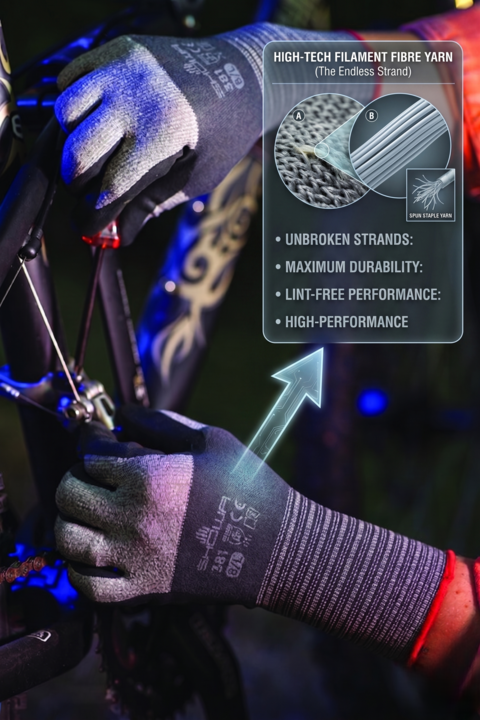
Staple fibers are short, discrete lengths of material – usually measured in inches. Natural fibers like cotton and wool are always staple fibers.
- The Process: These short bits are twisted together (spun) to create a continuous thread.
- The Feel: Because of the millions of tiny ends poking out of the twist, staple fibers feel soft and “fuzzy.”
- The Trade-off: While they are excellent for comfort and sweat absorption, those tiny ends can break off, leading to linting. If you’re working in a paint booth or a cleanroom, staple fibers are usually a no-go.
2. Filament fibers (The Endless Strand)
Filament fibers are continuous strands of indefinite length. Most synthetic materials, like Nylon, Polyester, and high-performance HPPE (like Dyneema®), begin as filaments.
- The Process: These are extruded through a spinneret, resulting in a smooth, long cord.
- The Benefits: Because there are no “ends” to fray or shed, filament yarns are incredibly high-strength and virtually lint-free.
- Specialty Filaments: In cut-resistant gloves, we often see glass fiber or stainless steel filaments “wrapped” inside other yarns to provide a structural core of protection.
| Feature | Staple fibers | Filament fibers |
| Common Examples | Cotton, Wool, Recycled Yarn | Nylon, HPPE, Glass, Steel |
| Texture | Soft, matte, fuzzy | Smooth, shiny, sleek |
| Lint Level | Higher (prone to shedding) | Very Low (cleanroom friendly) |
| Durability | Moderate | High |
Understanding Gauge: The Density of Protection
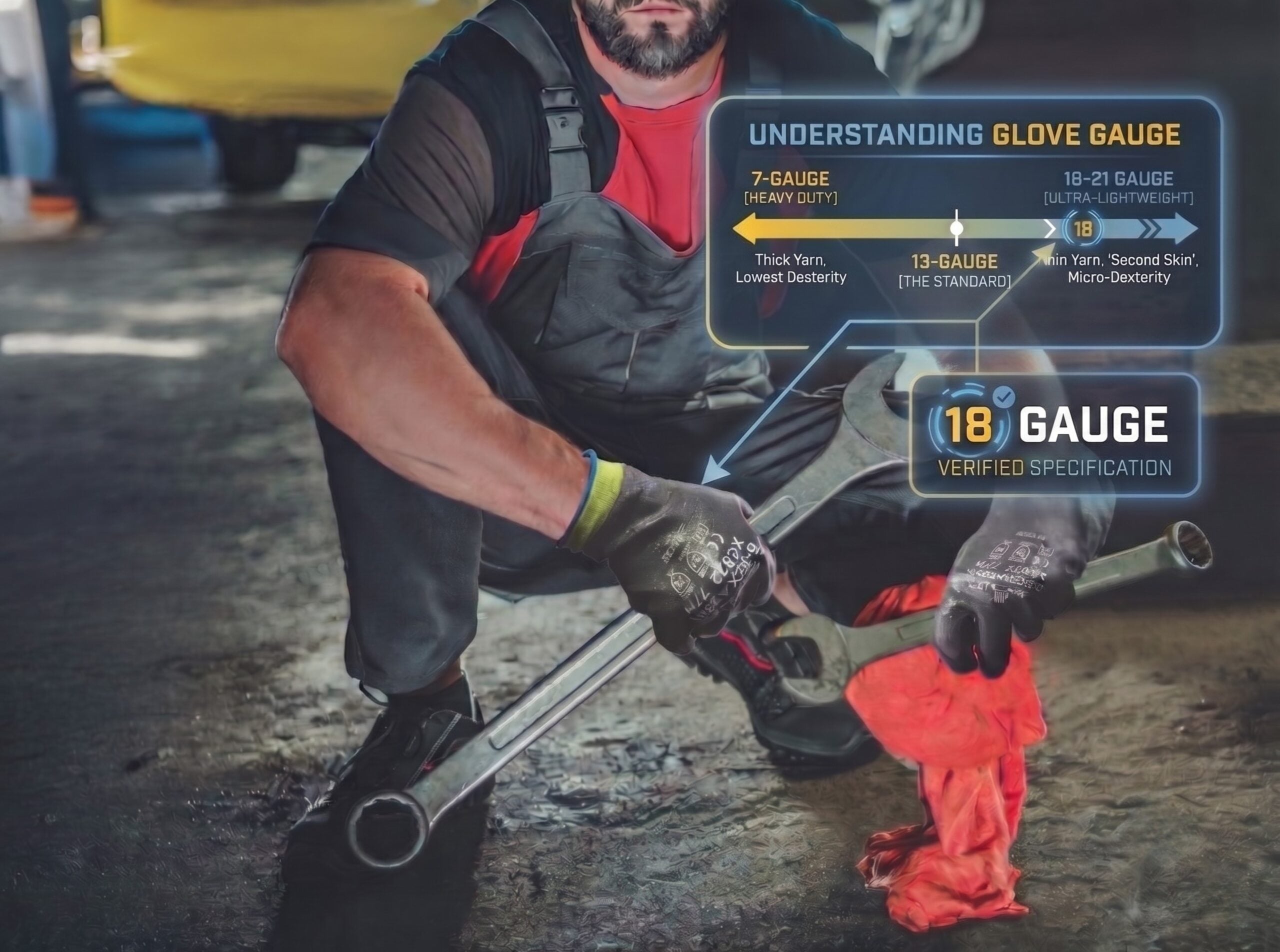
Once the fiber is chosen, it’s fed into a knitting machine. This is where Gauge comes in. In the textile world, gauge refers to the number of needles used per inch of fabric.
The Rule of Thumb: The higher the gauge number, the thinner and more flexible the glove.
The Spectrum of Performance
- 7-Gauge (Heavy Duty): These are the thick, chunky knits. With only 7 needles per inch, the yarn used is very thick. These offer excellent cushioning and heat resistance but zero precision.
- 13-Gauge (The Standard): This is the “sweet spot” for general purpose work. It offers a balance of durability and enough dexterity to pick up a bolt or thread a small nut onto a
- 18 to 21-Gauge (Ultra-Lightweight): This is the cutting edge of glove tech. These gloves are incredibly thin, feeling like a second skin. They allow for “micro-dexterity,” such as handling tiny electronics or feeling for imperfections in a finish, while still offering high cut protection thanks to modern filament cores.
Why Does It Matter?
Choosing a 21-gauge filament nylon glove gives you a precise level of touch and zero lint, perfect for electronics assembly. Conversely, a 7-gauge staple cotton glove is a cost-effective, breathable choice for heavy-duty lumber handling where “feel” isn’t the priority.